

What is HIL Testing in Automotive?
HIL (Hardware in the Loop) Testing in automotive is a validation technique where an actual Embedded Control System is connected to the real-time simulation of the vehicle & its environment. HIL Engineers can test how the vehicle behaves in real-life situations without needing a physical vehicle, which makes development faster, safer, & more cost-effective. The simulator emulates the overall system dynamics, actuators, & sensors, developing a closed-loop unit for the controller to set up with.
Why is HIL Testing Important?
HIL testing is crucial because it enables the early detection of errors in complex embedded systems. It significantly reduces development costs & time, and enhances safety by simulating hazardous conditions in a controlled environment. It enables thorough and repeatable testing of hardware and software integration in real-time, improving overall product quality and reliability for systems like those IoT in cars used in the automotive and aerospace industries. (IoT) in a real-time environment.
Benefits of HIL Testing in Automotive Development
Early error detection
Hardware in loop testing in automotive helps find problems between software & hardware early in the design process. Fixing issues early is much economical than fixing them after the product is built.
Saves time & money
It reduces the need for physical prototypes. Engineers can run many test scenarios repeatedly, which is faster & more cost-effective than testing with real hardware.
Better safety
Engineers can simulate dangerous or rare situations, like sudden brake failure, without risking people or damaging equipment.
Thorough testing
Hardware in loop testing in automotive encompasses various conditions & edge cases that are challenging to replicate in real-life scenarios.
Higher product quality
It ensures sensors, control units, & software work reliably, leading to better products.
Lower risk
HIL (Hardware in the Loop) Testing ensures safety & regulatory compliance, reducing the chances of failure in real-world use.
Supports complex systems
It is useful for testing advanced systems like autonomous driving (ADAS) or IoT devices in real-time.
How HIL Testing Works: Step-by-step
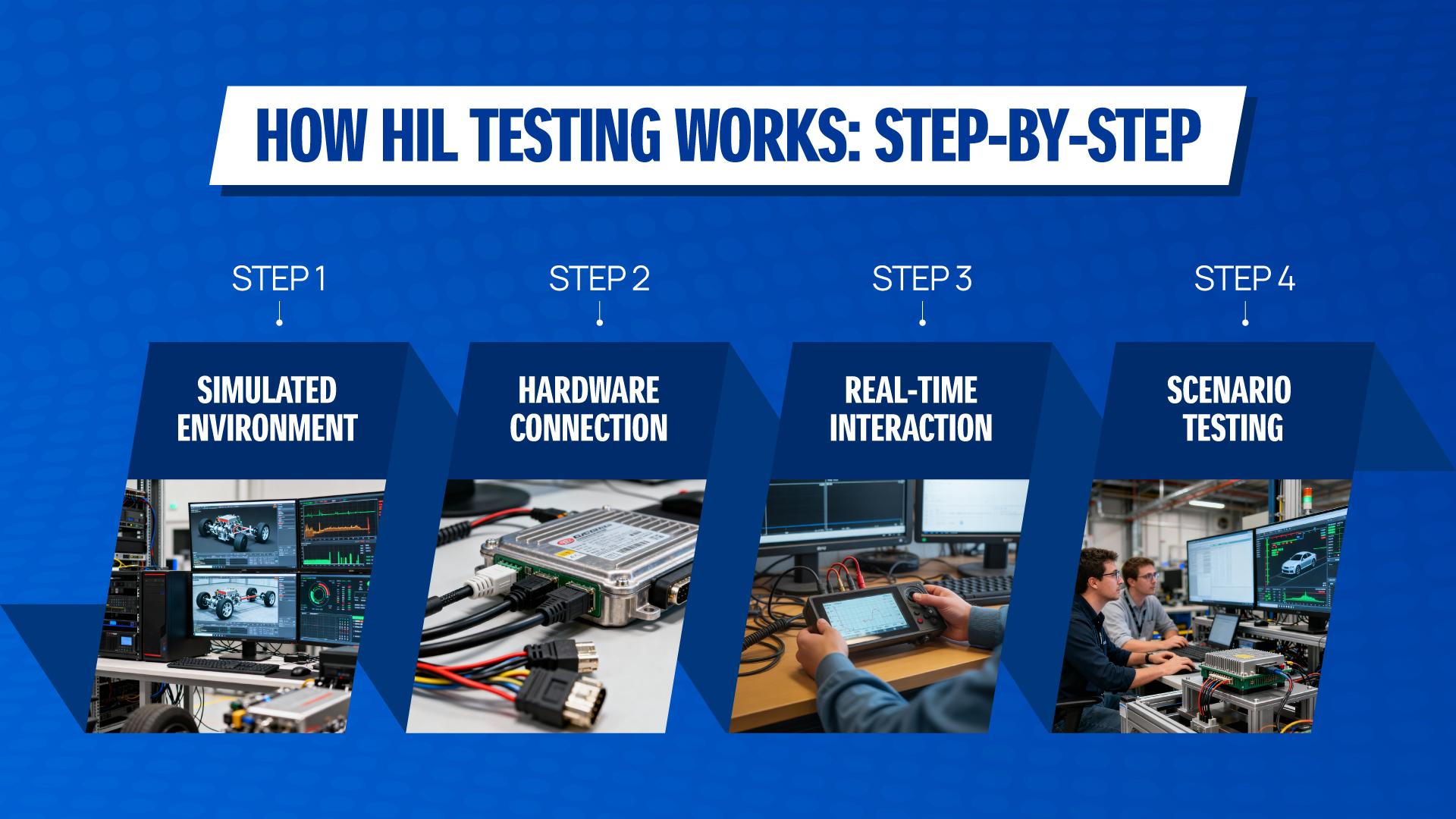
Step 1: Simulated Environment
A robust computer system runs a real-time simulation of the vehicle’s framework. It includes engines, drivetrain, sensors, & chassis dynamics.
Step 2 : Hardware Connection
The real physical ECU (which was tested) is connected to this simulation system through specialized interfaces.
Step 3 : Real-time Interaction
The simulation sends inputs to the ECU as if it were a real vehicle (For example, a simulated sensor reading). And then the ECU responds by sending outputs back to the simulation.
Step 4 : Scenario Testing
Engineers use Hardware in Loop testing in automotive to create & run different types of test scenarios (such as normal driving conditions, edge cases, & fault conditions) that would be difficult or dangerous to replicate with a physical vehicle.
Tools and Platforms Used in HIL Testing
Key applications for HIL in automotive
Advanced Driver Assistance Systems (ADAS) & Autonomous Driving
- Sensor Simulation: Check lane-keeping, adaptive cruise control, & emergency brakes using signals from cameras and radar.
- Vehicle Control Integration: Make sure the car responds correctly to pedestrians, obstacles, & automated driving situations.
2. Electric & Hybrid Cars
- Battery Testing: Check the software that controls the battery.
- Power Parts: Test inverters, converters, & other power components.
- Charging Systems: Test smart charging features.
- Electric Motor: Test the main motor that moves the car.
3. Engine and Transmission
- Engine Control: Test engine functions and emissions.
- Gear Shifting: Test transmission systems.
- Efficiency: Make electronics work better and stay cool.
4. Safety Systems
- ABS Testing: Check anti-lock brakes in different situations.
- Other Safety Features: Test important safety parts to ensure they work well.
5. Connectivity & Entertainment
- Communication Testing: Check Bluetooth, keyless entry, & other car communication systems safely.
What are the Challenges Faced in HIL Testing of an Automotive System?
Cost & Complexity
- High initial investment: HIL systems need specialised hardware & software. They can be expensive.
- Complex integration: Combining sensors, ECUs, & communication systems requires careful setup and expertise.
- Model accuracy: The simulation model must closely match the real vehicle; even small errors can lead to incorrect results.
Technical Challenges
- Real-time performance: Simulations must respond instantly since automotive systems rely on precise timing.
- Synchronization & timing: Coordinating multiple ECUs, sensors, & networks without timing mismatches is difficult.
- Hardware limitations: Physical sensors & actuators have real-world performance limits that affect testing accuracy.
- Data management: Handling & analyzing large amounts of hardware-in-the-loop simulation data efficiently is a major challenge.
Personnel & Process
- Skill gaps: Engineers need in-depth knowledge of both software & hardware to perform effective HIL testing.
- Configuration & version control: Managing multiple software versions & test setups can easily cause errors.
- Test case design: Designing complete, relevant, & non-redundant test cases for all possible scenarios is challenging.
- System complexity: Modern vehicles have many interconnected systems, making end-to-end testing difficult.
Cost & Complexity
- High initial investment: HIL systems need specialized hardware & software, which can be expensive.
- Complex integration: Combining sensors, ECUs, & communication systems requires careful setup and expertise.
- Model accuracy: The simulation model must closely match the real vehicle; even small errors can lead to incorrect results.
Technical Challenges
- Real-time performance: Simulations must respond instantly since automotive systems rely on precise timing.
- Synchronization & timing: Coordinating multiple ECUs, sensors, & networks without timing mismatches is difficult.
- Hardware limitations: Physical sensors & actuators have real-world performance limits that affect testing accuracy.
- Data management: Handling & analysing large amounts of simulation data efficiently is a major challenge.
Personnel & Process
- Skill gaps: Engineers need in-depth knowledge of both software & hardware to perform effective HIL testing.
- Configuration & version control: Managing multiple software versions & test setups can easily cause errors.
- Test case design: Designing complete, relevant, & non-redundant test cases for all possible scenarios is challenging.
- System complexity: Modern vehicles have many interconnected systems, making end-to-end testing difficult.
Future of Hardware-in-the-Loop (HIL) in Automotive
Hardware-in-the-Loop (HIL) testing is expected to play an even bigger role in the automotive industry as vehicles become more complex, connected, & software-driven.
The rise of Electric Vehicles technology (EVs), autonomous cars, & software-defined vehicles (SDVs) is driving the need for safer, faster, & cost-effective testing solutions.
Advanced Simulation & Virtual Testing
- Virtual HIL (vHIL): Engineers will use virtual prototypes earlier in development, often through cloud-based platforms, to test systems continuously.
- Sensor Fusion Validation: HIL will simulate realistic driving scenarios to test how sensors like LiDAR for cars, radar, and cameras work together for autonomous driving.
Integration of AI & Machine Learning
- AI-driven Testing: Artificial intelligence will create, optimize, and run complex test cases, including rare edge cases that are difficult to test in the real world.
- Predictive Testing: AI will analyze HIL test data to identify potential failures and predict system behavior, helping engineers resolve issues faster.
Stronger Focus on Cybersecurity
- Simulating Cyber Threats: HIL will be used to test how vehicles handle cyberattacks and network disruptions.
- Testing OTA Updates: Over-the-air software updates will be safely tested in HIL environments to ensure new features work without introducing vulnerabilities.
HIL for EVs and Powertrains
- Battery Management Systems (BMS): HIL will test batteries under different temperature and voltage conditions to improve safety and lifespan.
- Powertrain Optimization: Electric and hybrid powertrains can be tested and refined efficiently using HIL, reducing the need for costly physical prototypes.
Modular, Scalable, & Immersive Systems
- Flexibility and Adaptability: Future HIL platforms will be open, modular, and easy to customize for different types of vehicles.
- Mixed-Reality Testing: Combining HIL with VR and AR will help engineers visualize complex system interactions in 3D.