

Connected Car Safety Systems
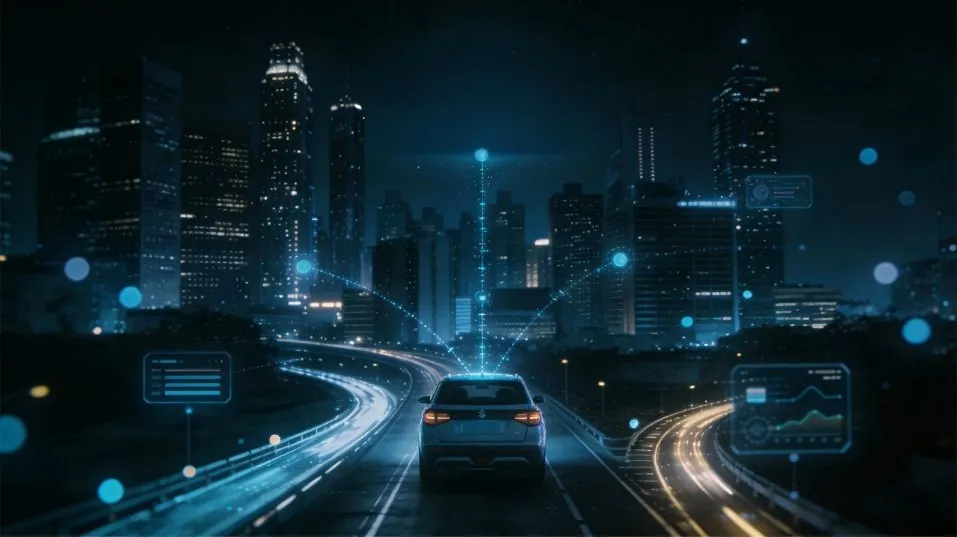
Connected car safety includes using technology to upgrade road safety through features such as Vehicle to Infrastructure, Vehicle to Vehicle, emergency alerts, communication, & ADAS. These systems enhance emergency response & accident avoidance.
Understanding the Connected Car Safety System
A connected car is a smart vehicle designed to enhance connected vehicle safety, comfort, & convenience through advanced communication technologies. It uses:
- 4G/5G networks
- Wi-Fi, Bluetooth
- A Telematics Control Unit (TCU)
- On-board sensors to share information in real time.
Together, they allow the car to monitor its own condition, surroundings, & driving behavior. The data collected helps in sending alerts. This provides safety warnings, & even takes automatic actions to avoid potential risks.
With these intelligent features, connected car safety technologies make driving more efficient, secure, & enjoyable. It creates a smoother & safer experience on every journey with advanced car safety systems.
Benefits of Connected Car Safety Systems
Real-time hazard alerts
The system warns drivers about dangers ahead. It can detect things like a sudden stop by another car or someone crossing the road.
Collision prevention
By sharing data, cars help drivers avoid unseen accidents. This includes vehicles coming from a blind turn or a hidden spot.
Better driving habits
Connected cars track driving patterns. It also gives feedback on speed, braking, & acceleration to help drivers improve their safety.
Remote health check
The car can alert drivers about issues like a low battery or worn brake pads. This helps fix problems early before they become serious.
Automatic safety actions
In some cases, the system can take action on its own. For example, it can stop the car if it detects a pedestrian that the driver hasn’t noticed.
Types of Connected Car Safety Systems
⭐Active Safety Systems in Cars
Anti-lock Braking System (ABS):
- Prevents wheels from locking during sudden braking.
- Helps the driver steer safely and avoid skidding.
Electronic Stability Control (ESC):
- Keeps the car stable during sharp turns or on slippery roads.
- Reduces the risk of losing control.
Automatic Emergency Braking (AEB):
- Applies brakes automatically if a collision is detected.
- Prevents or reduces the severity of accidents.
Lane Departure Warning:
- Alerts the driver when the car drifts out of its lane.
- Helps maintain lane discipline and avoid accidents.
Blind Spot Detection:
- Monitors and detects vehicles in the driver’s blind spots.
- Makes lane changes safer.
Adaptive Headlights:
- Headlights move in the direction of the steering.
- Improves visibility and safety during night driving.
Tyre Pressure Monitoring System (TPMS):
- Alerts the driver when the tyre pressure is low.
- Maintains tyre health, grip, and fuel efficiency.
⭐Passive Safety Systems in Cars
Seatbelts:
- Hold passengers firmly during a crash.
- Reduce the risk of serious injuries.
Airbags:
- Inflate instantly during a collision.
- Protect passengers from strong impacts.
ISOFIX Mounts:
- Provide fixed anchor points for child safety seats.
- Keep child seats secure and stable.
Crumple Zones:
- Absorb crash energy in the front and rear of the car.
- Protect passengers inside the cabin.
Strong Vehicle Body Structure:
- Designed to withstand crashes and impacts.
- Keeps the passenger compartment safe during accidents.
These active and passive safety systems in automobiles work together to improve road safety and protect lives.
How Connected Car Safety Systems Work?
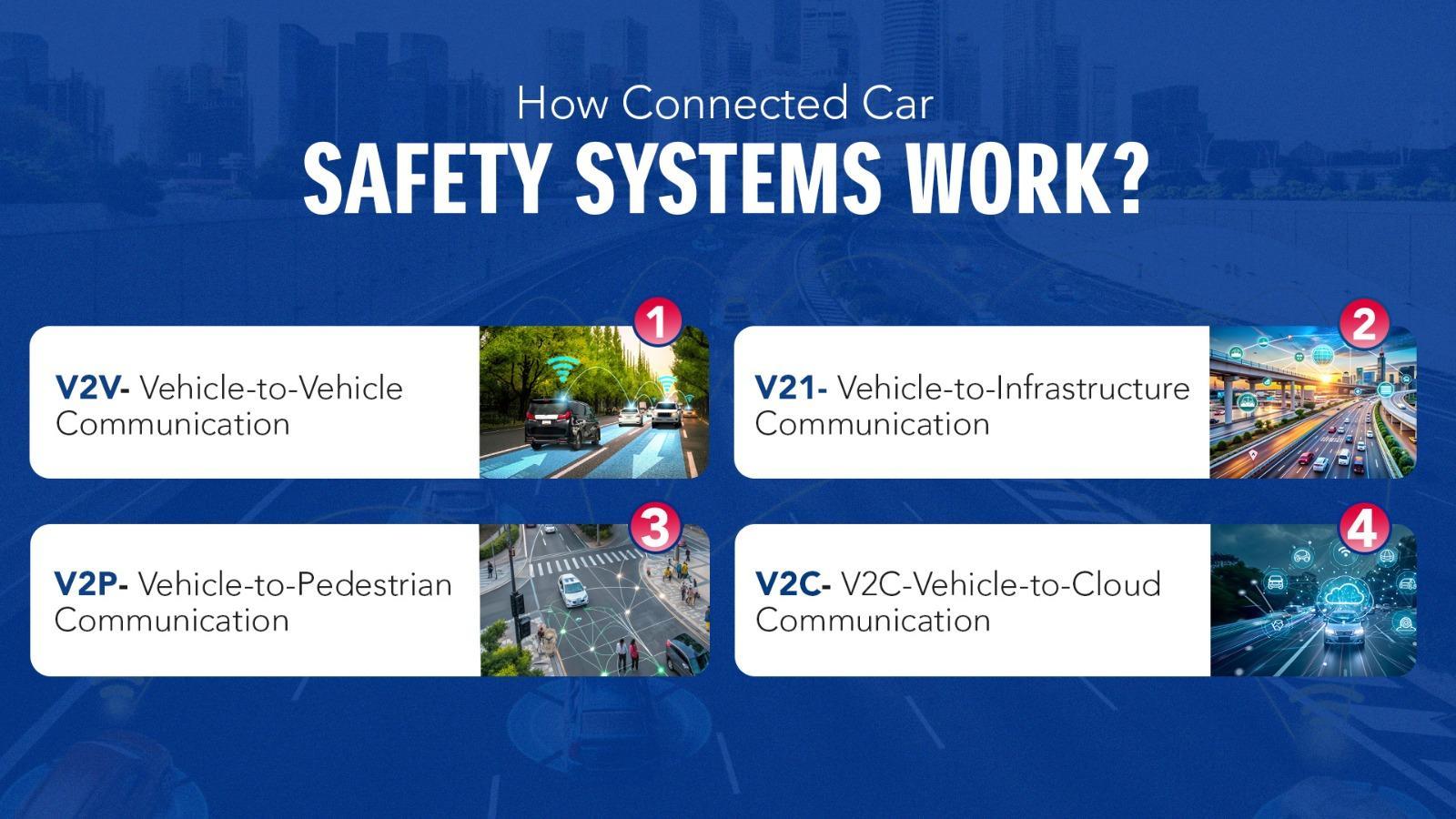
V2V – Vehicle-to-Vehicle Communication
- Cars share real-time details like speed, direction, & location with each other.
- Helps in sending instant alerts to prevent collisions & accidents.
V2I – Vehicle-to-Infrastructure Communication
- Vehicles connect with road systems such as traffic lights, cameras, & sensors.
- Improves traffic flow & reduces congestion. It provides warnings about road conditions.
V2P – Vehicle-to-Pedestrian Communication
- Detects nearby pedestrians and cyclists using sensors & smart systems.
- Sends instant alerts to the driver to avoid accidents, especially in low-visibility situations.
V2C – Vehicle-to-Cloud Communication
- Cars connect to the internet cloud for data on routes, weather, & traffic.
- Enables remote monitoring, vehicle health checks, & timely software updates.
These connected car safety devices & systems make up a complete vehicle safety system. They are designed for real-time communication & safer driving.
Key Technologies Powering Connected Car Safety
| Category | Feature | Meaning |
| ADAS | Automatic Emergency Braking | The car automatically applies brakes if it senses a crash. |
| Lane Keeping Assist & Lane Departure Warning | Keeps the car in its lane & warns if it moves out. | |
| Adaptive Cruise Control | Controls car speed to keep a safe gap from the car ahead. | |
| Blind Spot Monitoring | Alerts the driver if another car is in the blind spot. | |
| Driver Monitoring System | Check if the driver is sleepy or not paying attention. | |
| V2X | Vehicle-to-Vehicle | Cars share data like speed and location with each other. |
| Vehicle-to-Infrastructure | Cars connect with traffic lights, cameras, and sensors. | |
| Vehicle-to-Pedestrian | Detects people or cyclists near the car. | |
| Vehicle-to-Network | Connects to the internet for updates. | |
| Sensors & Hardware | Radar | Uses radio waves to find the distance & speed of other objects. |
| LiDAR | Uses laser light to see the surroundings in 3D. | |
| Cameras | Capture road signs, lanes, & obstacles. | |
| Ultrasonic Sensors | Detect things close to the car. | |
| GPS & IMU | Show the car's exact location & movement. | |
| AI & Data | Real-time Hazard Detection | Quickly finds obstacles or dangers on the road. |
| Predictive Analytics | Checks car parts & driving behavior. | |
| Sensor Fusion | These combine to form a smart car safety device setup. | |
| Cybersecurity & Software | Encryption & Authentication | Keeps car data safe from hackers. |
| Over-the-Air Updates | Enhance automobile safety technology through intelligent decision-making. | |
| Intrusion Detection System | Finds & blocks hacking attempts. |
Together, these technologies make up the ADAS system for cars. They provide the best car safety technology that ensures safer roads & smarter mobility.
Examples of Safety Features
Automatic Emergency Braking with connectivity support
The system detects a collision risk & brakes the car automatically. With connectivity, it may also warn nearby cars.
Blind-Spot Detection & Lane Change Assist
Improves driver awareness through active safety systems! The vehicle alerts the driver if another vehicle is in the blind spot. The connectivity can support additional warnings from other vehicles or infrastructure.
Traffic Light & Infrastructure Alerts (V2I)
Part of connected safety networks that enhance urban mobility! Cars receive warnings if a traffic light is about to change, or if there is a hazard ahead (roadworks, accident) from smart infrastructure.
Pedestrian/Cyclist Detection (V2P)
A core part of modern automobile safety systems. The car detects a person or a cycle entering a road & either alerts or takes action to avoid a collision.
Vehicle Health Alerts
The car monitors its own components. This includes battery, tyre pressure & brakes. It then sends alerts to the driver's smartphone or service center before a failure occurs.
Connectivity Services
Remote tracking, geofencing (car leaves designated zone), teen-driver monitoring, stolen vehicle tracking, etc. These services improve overall driver behavior & reduce risk.
OTA Safety & Software Upgrades
Keep the system updated with the latest connected car safety technologies. When new safety logic is developed, it can be sent to the car remotely. It improves its safety systems over time without needing service visits.
Such features turn the vehicle into a safer, stronger partner on the road.
Challenges in Connected Car Safety
Connectivity & Infrastructure Limits:
Many regions still struggle with poor internet connectivity & underdeveloped road infrastructure, which prevents connected car systems from performing at their full potential.
Cybersecurity & Privacy Risks:
Since connected cars rely on the internet, they are vulnerable to hacking & data theft. Strong security measures and data protection systems are crucial for user safety.
High Cost & Affordability:
Advanced sensors, processors, & smart systems make connected cars expensive. These features are currently more accessible in premium vehicles, limiting mass adoption.
Compatibility & Standardisation Issues:
For vehicles & infrastructure to communicate effectively, they must follow the same standards. Different systems can lead to data mismatches or communication failures.
Driver Trust & Human Factors:
Some drivers may find it difficult to trust systems that take control or give frequent alerts. Building user confidence through reliable & intuitive interfaces is essential.
Data Management & Scalability:
Connected vehicles generate vast amounts of data that must be processed, stored, & secured in real time, which poses a major technical challenge.
Mixed Traffic & Complex Roads:
India’s roads feature cars, bikes, pedestrians, & even animals sharing space. Connected car systems must be intelligent enough to handle such unpredictable conditions.
The Future of Connected Car Safety
Wider deployment of V2X & V2P communication
Future vehicles will feature predictive safety, better V2X connectivity, & integration into smart mobility ecosystems. As infrastructure improves, vehicles will increasingly “communicate” to each other, to the road, to traffic lights & to pedestrians’ smartphones.
It will give real-time data, which means proactive safety.
Integration with autonomy & ADAS
With advanced sensors & connectivity, vehicles will move from driver-assisted to semi-autonomous and eventually autonomous operation. This will reduce human error, a major cause of accidents.
AI-based predictive safety
Not just reacting to hazards, but predicting them, based on driver behavior, road condition, & environment, and intervening early. So, as automobile safety technology evolves, connected vehicle safety will reach new levels through AI & automation.
Smart cities & connected mobility ecosystems
Vehicles will be part of a larger mobility system, including public transport, traffic management systems & urban infrastructure. This will make roads safer and travel more efficient.
Affordability & scalability in emerging markets
Over time, affordable connected car systems will make these safety features accessible to more people worldwide. This will make connected safety accessible to many more people.
Consistent updates & vehicle-lifecycle safety
Vehicles will get software updates over their life, improving safety systems remotely without needing to buy a new car.
Conclusion
Connected car safety systems represent a big step forward in automobile safety systems. By combining sensors, connectivity, smart data & quick action, vehicles become proactive partners in vehicle safety systems.
At Suzuki research and development are dedicated to bringing these innovations into real life, vehicles that are not only convenient & efficient but also secure and reliable for every driver, everywhere.
As we move towards a more connected world, we remain committed to delivering safety that you can trust & drive with peace of mind.